


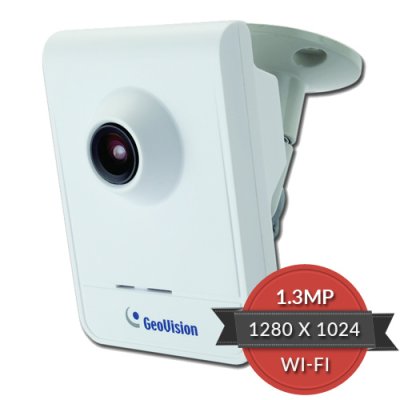

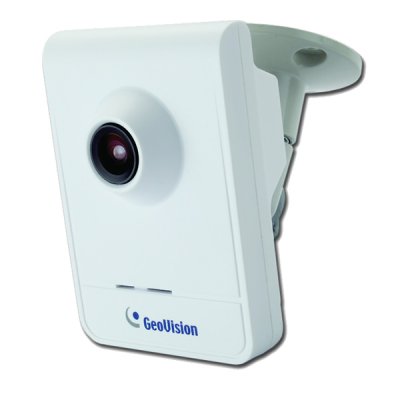

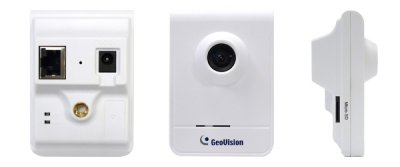

GV-CBW-120 Geovision 3.35mm 1280 x 1024 Wireless Indoor Color Cube IP Security Camera 12VDC

This wireless surveillance camera is small and discreet and works best indoors. It can record 30 frames per second with a 1280 x 1024 resolution. The security camera comes with a built-in microphone so it can also record audio. It is also equipped with a 3.35mm lens, motion detection and day/night function. Power is supplied by 12V/DC. FEATURES are 1/2.5’’ Progressive Scan CMOS. Stream 1 from H.264 and MJPEG is Stream 2 from H.264, MPEG4 and MJPEG, Up to 30 fps at 1280 x 1024. Wireless connectivity Wi-Fi 802.11/b/g/n. Built-in speaker and microphone, Micro SD/SDHC Card Slot, G.711 and AAC audio codec. Motion detection, Tampering alarm, Privacy mask, IP address filtering, Megapixel lens, Supports iPhone, iPad, Android & 3GPP, 28 languages on Web interface. These two features are not unique as I’ve reviewed the AVTech and Axis cube cameras that also have this functionality. What makes this camera more unique is that its a day/night camera, meaning it has an IR cut filter to change to IR mode at night and has a bright IR LED that provides nearly invisible lighting indoors as you’ll see later. Many of the competitors like AVTech and Axis are day only cameras that rely on a very bright but annoying white LED to provide night vision. IR is much better and more practical in real life and can be used more discretely. The other feature this camera has is the ability to record to an microSD card and has full playback capabilities comparable to good NVR solutions with a calendar and timeline that can be scrubbed to find the event you are looking for. Alerts can be sent via e-mail if needed.
This wireless surveillance camera is small and discreet and works best indoors. It can record 30 frames per second with a 1280 x 1024 resolution.
- Shipping info
We deliver worldwide
- Payment methods

- Return Policy
We accept returns
- Customer Reviews
Check out our customer Reviews
This wireless surveillance camera is small and discreet and works best indoors. It can record 30 frames per second with a 1280 x 1024 resolution. The security camera comes with a built-in microphone so it can also record audio. It is also equipped with a 3.35mm lens, motion detection and day/night function. Power is supplied by 12V/DC. FEATURES are 1/2.5’’ Progressive Scan CMOS. Stream 1 from H.264 and MJPEG is Stream 2 from H.264, MPEG4 and MJPEG, Up to 30 fps at 1280 x 1024. Wireless connectivity Wi-Fi 802.11/b/g/n. Built-in speaker and microphone, Micro SD/SDHC Card Slot, G.711 and AAC audio codec. Motion detection, Tampering alarm, Privacy mask, IP address filtering, Megapixel lens, Supports iPhone, iPad, Android & 3GPP, 28 languages on Web interface. These two features are not unique as I’ve reviewed the AVTech and Axis cube cameras that also have this functionality. What makes this camera more unique is that its a day/night camera, meaning it has an IR cut filter to change to IR mode at night and has a bright IR LED that provides nearly invisible lighting indoors as you’ll see later. Many of the competitors like AVTech and Axis are day only cameras that rely on a very bright but annoying white LED to provide night vision. IR is much better and more practical in real life and can be used more discretely. The other feature this camera has is the ability to record to an microSD card and has full playback capabilities comparable to good NVR solutions with a calendar and timeline that can be scrubbed to find the event you are looking for. Alerts can be sent via e-mail if needed.
This wireless surveillance camera is small and discreet and works best indoors. It can record 30 frames per second with a 1280 x 1024 resolution. The security camera comes with a built-in microphone so it can also record audio. It is also equipped with a 3.35mm lens, motion detection and day/night function. Power is supplied by 12V/DC.
FEATURES
- 1/2.5’’ Progressive Scan CMOS
- Stream 1 from H.264 and MJPEG;
Stream 2 from H.264, MPEG4 and MJPEG - Up to 30 fps at 1280 x 1024
- Wireless connectivity: WiFi 802.11/b/g/n
- Built-in speaker and microphone
- Micro SD/SDHC Card Slot
- G.711 and AAC audio codec
- Motion detection
- Tampering alarm
- Privacy mask
- IP address filtering
- Megapixel lens
- Supports iPhone, iPad, Android & 3GPP
- 28 languages on Web interface
Camera | ||
Image Sensor | 1/2.5" progressive scan CMOS | |
Picture Elements | 1280 (H) x 1024 (V) | |
Minimum Illumination | Color | 1 Lux (1/30 sec), 0.5 Lux (1/5 sec) |
Shutter Speed | Automatic, Manual (1/5 ~ 1/8000 sec) | |
White Balance | Automatic, Manual (2800 ~ 8500K) | |
Gain Control | Gain Control | |
S/N Ratio | 45 dB | |
Lens | ||
Megapixel | Yes | |
Day/Night | Yes (electronic) | |
Lens Type | Fixed | |
Focal Length | 3.35 mm | |
Maximum Aperture | F/2.4 | |
Mount | M12 mm | |
Image Format | 1/3" | |
Angle of View | Diagonal | 142° |
Horizontal | 131° | |
Vertical | 112° | |
Operation | Focus | Focus |
Zoom | Zoom | |
Iris | Iris | |
Operation | ||
Video Compression | H.264, MPEG4, MJPEG | |
Video Stream | Stream 1 from H.264 and MJPEG | |
Frame Rate | 30 fps at 1280 x 1024 | |
Image Setting | Brightness, Contrast, Saturation, Sharpness, Gamma, White Balance, Flicker-less, Image Orientation, Shutter Speed, Backlight Compensation | |
Audio Compression | G.711, AAC (16 kHz / 16 bit) | |
Video Resolution | ||
Main Stream | 4:3 | 1280 x 960, 640 x 480, 320 x 240 |
16:9 | 1280 x 720, 640 x 360, 448 x 252 | |
5:4 | 1280 x 1024, 640 x 512, 320 x 256 | |
Sub Stream | 4:3 | 640 x 480, 320 x 240 |
16:9 | 640 x 360, 448 x 252 | |
5:4 | 640 x 512, 320 x 256 | |
Network | ||
Interface | 10/100 Ethernet | |
Ethernet Protocol | HTTP, HTTPS, TCP, UDP, SMTP, FTP, DHCP, NTP, UPnP, DynDNS, 3GPP/ISMA, RTSP, PSIA, SNMP, QoS (DSCP) | |
Wireless LAN | IEEE 802.11 b/g/n | |
Antenna Type | Bulit-in | |
Security | WEP, WPA-PSK(TKIP), WPA-PSK(AES), WPA2-PSK(TKIP), WPA2-PSK(AES) | |
Mechanical | ||
Lens Mounting | M12 mm | |
Temperature Detector | Yes | |
Connectors | Power | DC Jack |
Ethernet | Ethernet (10/100 Base-T), RJ-45 | |
Audio | Built-in speaker & microphone | |
Local Storage | Micro SD/SDHC memory card slot (for Class 6 card or above) | |
LED Indicator | 2 LEDs: Status, LAN | |
General | ||
Operating Temperature | 0 °C ~ 40 °C / 32 °F ~ 104 °F | |
Humidity | 10% to 90% (no condensation) | |
Power Source | 5V DC | |
Max. Power Consumption | 3.2 W | |
Dimensions | 60 x 84.8 x 39 mm / 2.36 x 3.34 x 1.54 in | |
Weight | 70 g / 0.15 lb | |
Regulatory | CE, FCC, C-Tick, RoHS compliant | |
Web Interface | ||
Installation Management | Web-based configuration | |
Maintenance | Firmware upgrade through Web Browser or Utility | |
Access from Web Browser | Camera live view, video recording, change video quality, bandwidth control, image snapshot, audio, Wide Angle Lens Dewarping, Picture in Picture, Picture and Picture, Privacy Mask, Tampering Alarm, Text Overlay | |
Language | Czech / Danish / English / French / German / Hebrew / Hungarian / Italian / Japanese / Polish / Portuguese / Russian / Serbian / Simplified Chinese / Spanish / Traditional Chinese | |
Applications | ||
Network Storage | GV-NVR, GV-System, GV-Backup Center, GV-Recording Server | |
Mobile Phone Support | GV-AView for Android Smartphone, GV-Eye HD for iPad, GV-Eye for iPhone and iPod Touch, GV-GView for Windows PDA, GV-MSView for Windows Smartphone, GV-SSView for Symbian Smartphone, 3G-enabled phone. | |
Live Viewing | IE , GV-MultiView | |
CMS Server support | GV-Center V2, GV-VSM, GV-Control Center | |
- ManufacturerGeovision
- Camera TypeWireless
- Camera SignalIP
- Shipping Lead TimeShips within 1 to 12 Hours
- WarrantyGeoVision Direct Warranty
- Remote Login SupportNo Login Support Needed, 1 Time FREE Setup: Remote Access Mobile App Configuration - Motion Detection Setup


The mission of WorldEyeCam, Inc.is to provide consumers with the most up to date security products at the best prices available on the market today. As security is advancing at such a rapid rate we try to exceed our customers expectations by providing unparallel customers service and technical support. We strive to stay on the forefront of the most up to date products and news in regards to our industry. Our website www.Worldeyecam.com contains a broad spectrum of surveillance products as well as industry information. Our website is updated daily as we make our way through this technological wave of security products. Our goal and focus is to stay on top of the latest innovations in technology and securities and to remain a trusted industry leader for years to come.
WorldEyeCamis a CCTV products distribution and integration company located in Southern California in the heart of Orange County. We operate out of a 14,000 sq.ft warehouse & a separate product demo show room. We proudly offer 1st class technical support for our customers we serve with the complete understanding that it is you, the customer that matters to every successful business. If you haven't already learned the hard way, you will understand that it takes more than just a website and the ability to sell a product - anyone can sell a product! But, it takes commitment to offerDEPENDABLE AND CONSISTENT technical support & customer SERVICE AFTER THE SALE. We stand behind our products 100% and we are in it for the long haul & to keep you, the customer happy.
Why Buy From The Worldeyecam Security Store. 30 Day Money Back Guarantee Latest Product Version Guarantee Fast Accurate Same Day Shipping Friendly customer service.
We are committed to providing our customers with "Complete Purchasing Experience Satisfaction" This means quality customer service from pre-purchase support, easy secure encrypted ordering, fast UPS shipping , comprehensive after sales tech-support by certified professionals and hassle free returns.
Shipping Information
FREE UPS Ground Shipping Continental US addresses on all orders over $1000.00 All in stock items are usually shipped Same Day (*not including weekends and holidays). For any Order for Bulk Cables that weigh over 75 lbs will be charged extra. Orders placed before 3 pm PST, or 2 pm for Expedited orders (Next Business Day Air or 2nd Business Day Air) can usually be shipped the same day. Orders placed by internet or by phone receive the same priority handling.

Why Buy From The Worldeyecam Security Store. 30 Day Money Back Guarantee Latest Product Version Guarantee Fast Accurate Same Day Shipping Friendly customer service.
We are committed to providing our customers with "Complete Purchasing Experience Satisfaction" This means quality customer service from pre-purchase support, easy secure encrypted ordering, fast UPS shipping , comprehensive after sales tech-support by certified professionals and hassle free returns.
Shipping Information
FREE UPS Ground Shipping Continental US addresses on all orders over $1000.00 All in stock items are usually shipped Same Day (*not including weekends and holidays). For any Order for Bulk Cables that weigh over 75 lbs will be charged extra. Orders placed before 3 pm PST, or 2 pm for Expedited orders (Next Business Day Air or 2nd Business Day Air) can usually be shipped the same day. Orders placed by internet or by phone receive the same priority handling.
Security Guaranteed
We use SSL (Secure Sockets Layer) encryption technology to ensure a secure end-to-end link We will never share your personal information, including your email address, with anyone or any company for any reason (except as required by law.)
This site uses the latest encryption technology to ensure that every transaction is a safe one. All transactions are processed over the Secure Socket Layer (SSL).Ordering from Worldeyecam online is very Safe and Secure. From the moment you enter our Shopping Basket or click on Checkout, you are on a secure server, We use what is called SSL (secure socket layer) technology. We use the highest bit encryption with SSL at 128 bits. Your credit cards are encrypted when they are transmitted to us and are stored in a secure environment.